2026 and 2027 Small Group Classes for K-8th
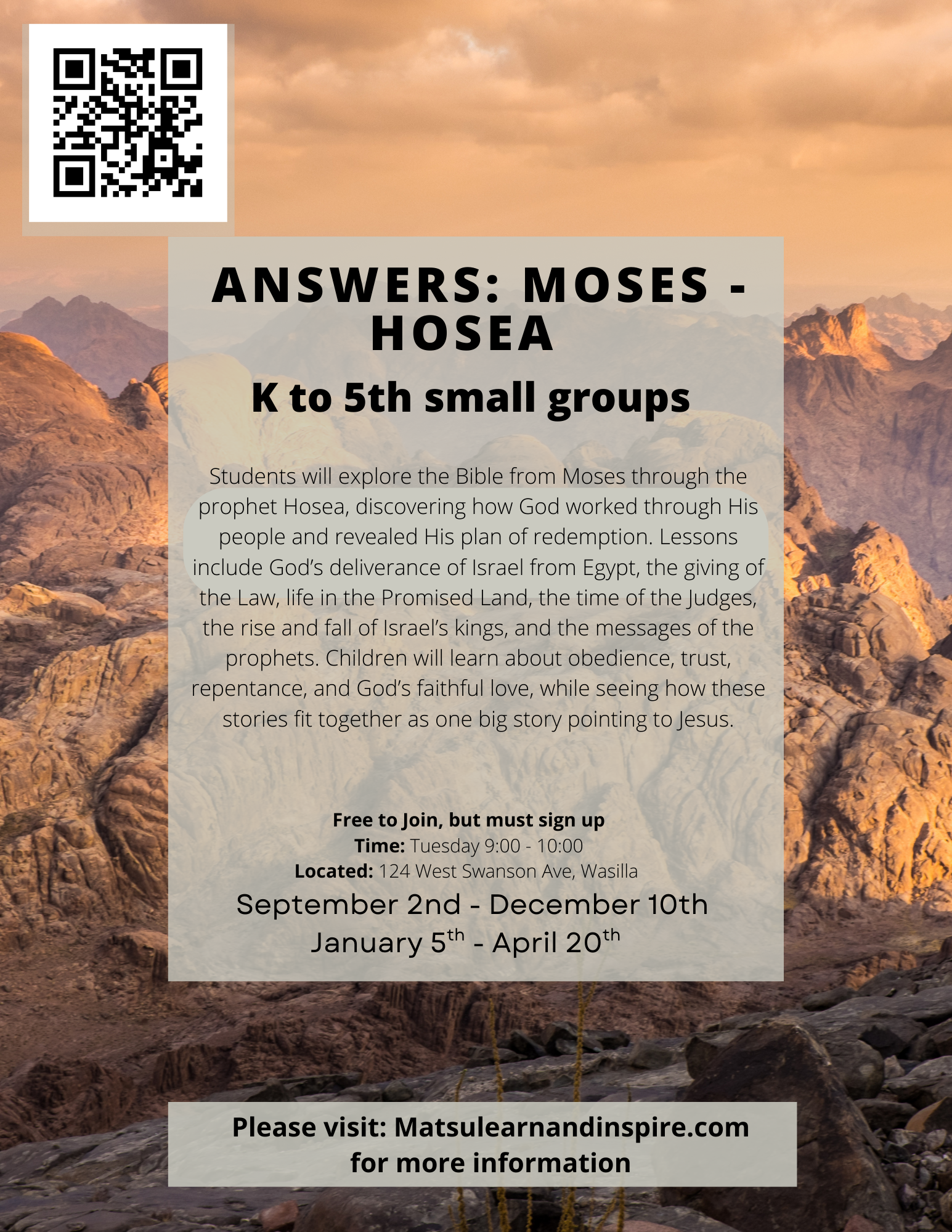
Answers: Moses - Hosea
Students will explore the Bible from Moses through the prophet Hosea, discovering how God worked through His people and revealed His plan of redemption. Lessons include God’s deliverance of Israel from Egypt, the giving of the Law, life in the Promised Land, the time of the Judges, the rise and fall of Israel’s kings, and the messages of the prophets. Children will learn about obedience, trust, repentance, and God’s faithful love, while seeing how these stories fit together as one big story pointing to Jesus.
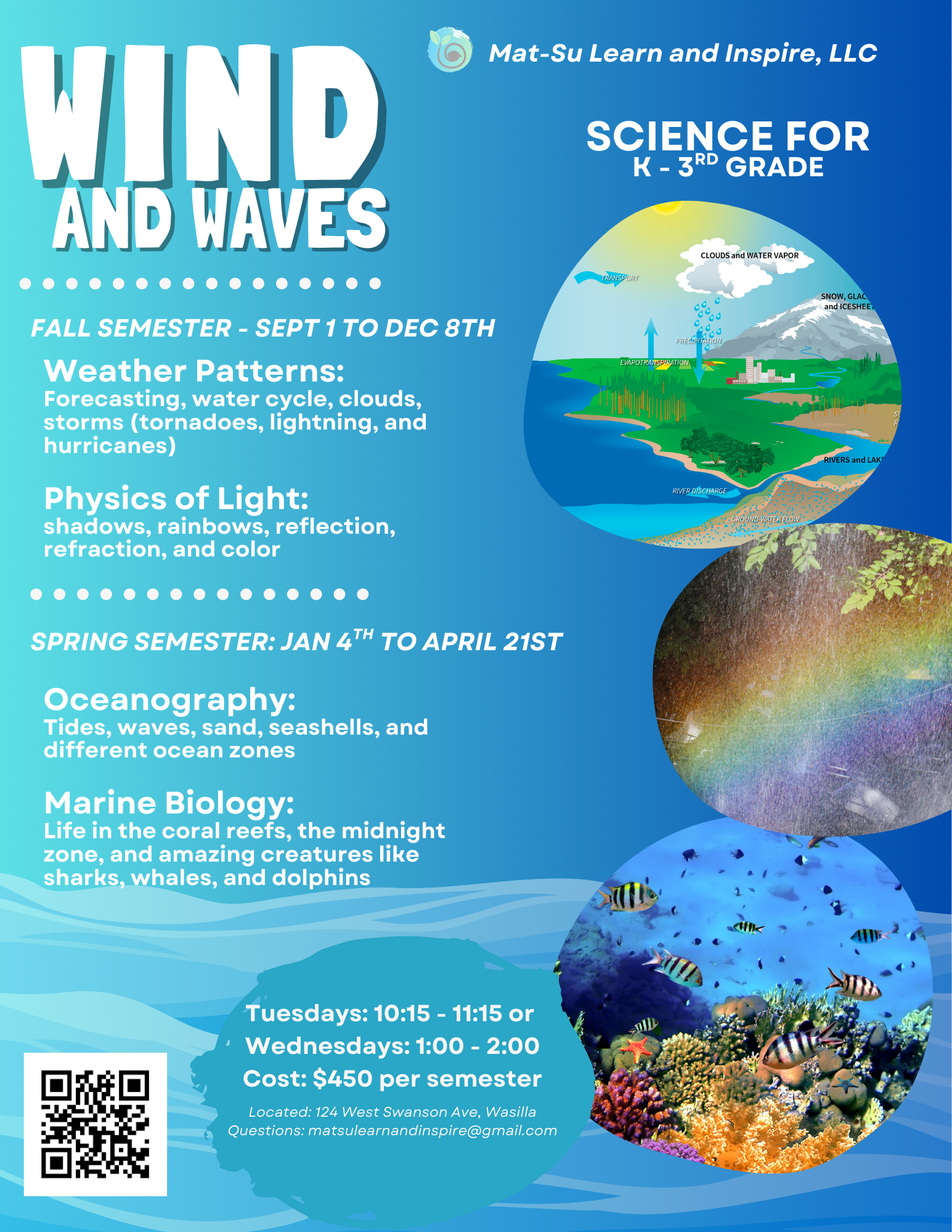
Wind and Waves: Fall Semester
This hands-on course is designed specifically for Kindergarten through 3rd graders, blending wonder-filled discovery with essential classroom skills. We use The Good and the Beautiful curriculum to investigate the powerful forces of weather and the mysteries of the deep blue sea.
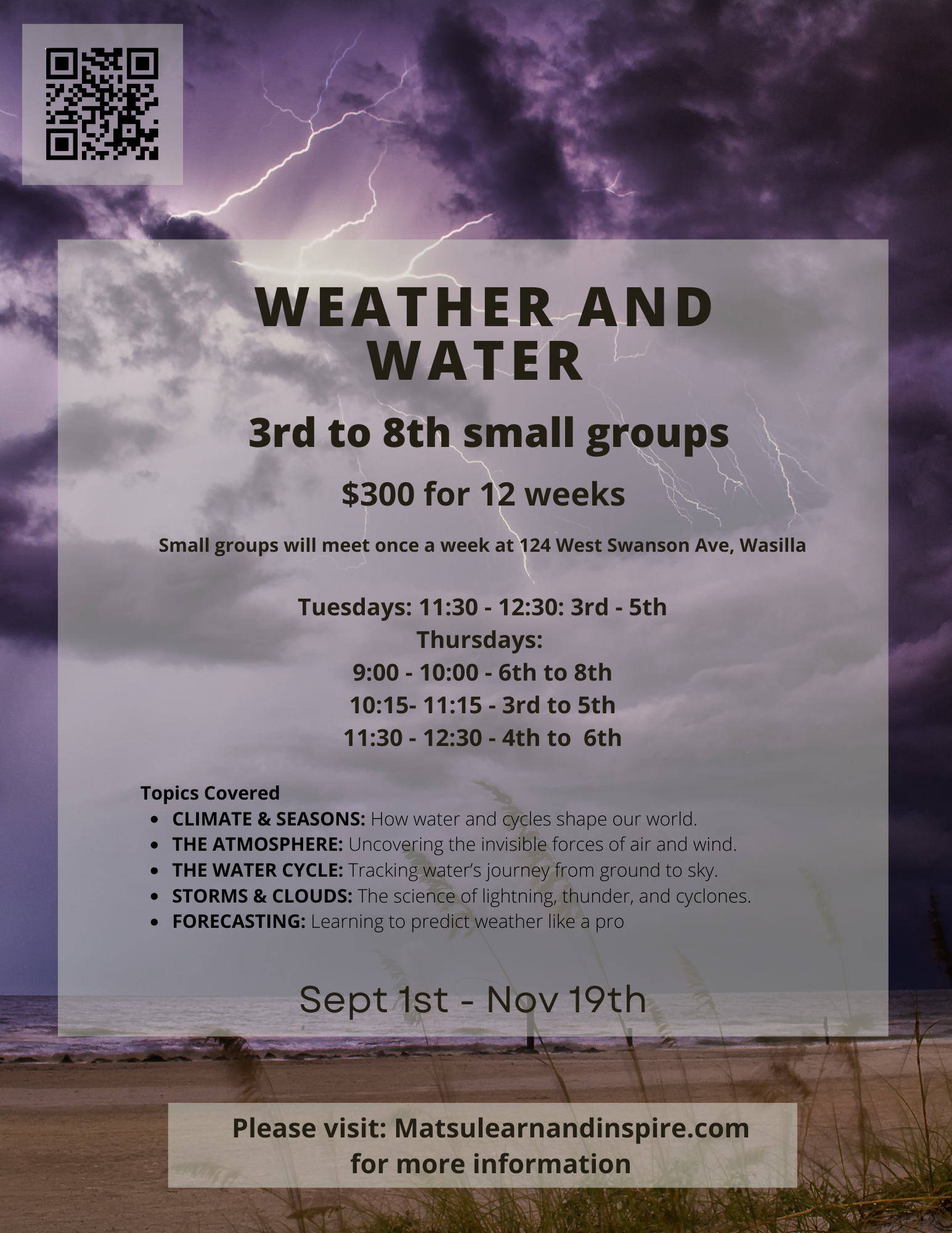
Weather and Water: 3rd - 8th Grade Science
Topics Covered
Climates and Seasons: How water and cycles shape our world.
The Atmosphere: Uncovering the invisible forces of air and wind.
The Water Cycle: Tracking water’s journey from ground to sky.
Storms and Clouds: The science of lightning, thunder, and cyclones.
Forecasting: Learning to predict weather like a pro
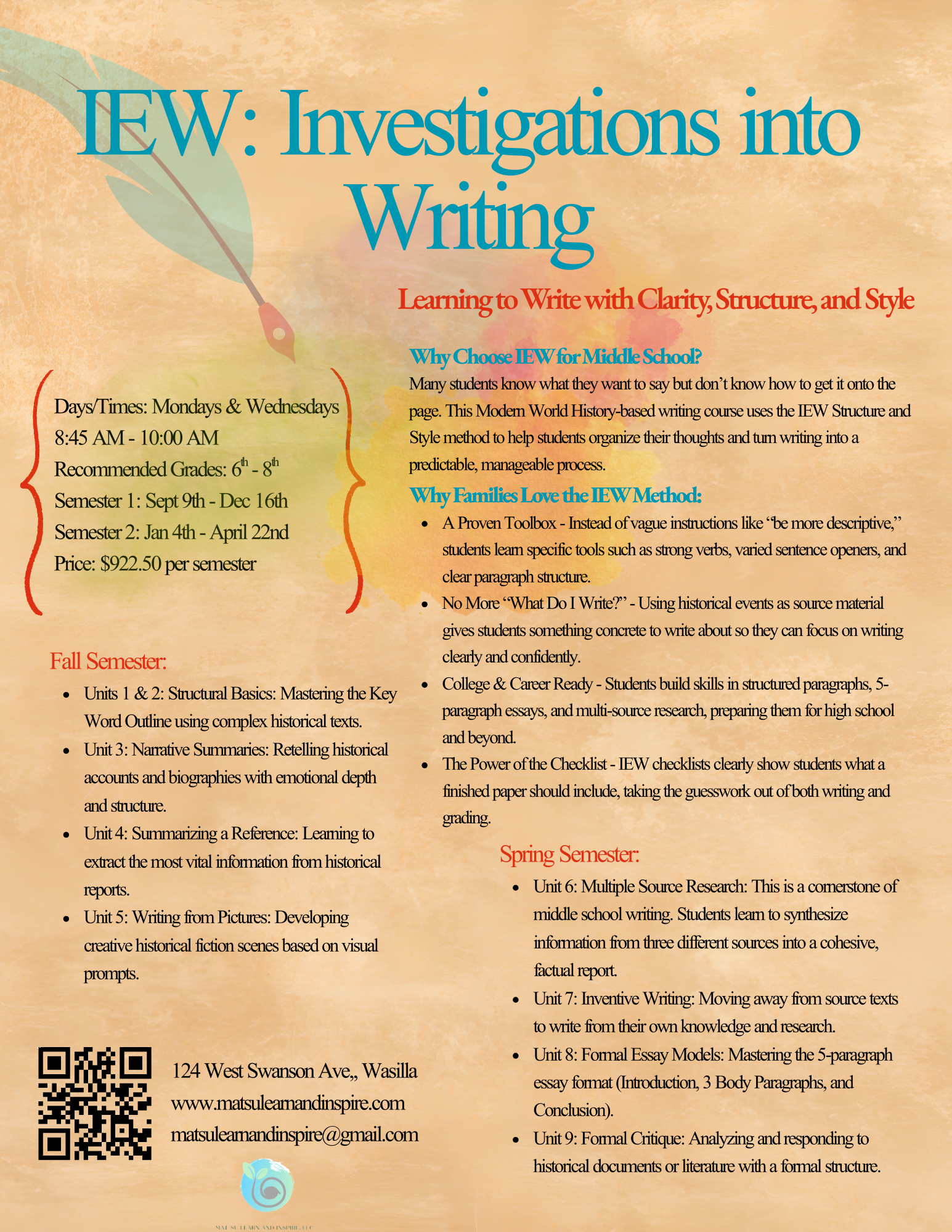
IEW: Investigations in Writing 6th - 8th - Fall Semester
Why Choose IEW for Middle School?
Many students know what they want to say but don’t know how to get it onto the page. This Modern World History-based writing course uses the IEW Structure and Style method to help students organize their thoughts and turn writing into a predictable, manageable process.
Why Families Love the IEW Method:
A Proven Toolbox - Instead of vague instructions like “be more descriptive,” students learn specific tools such as strong verbs, varied sentence openers, and clear paragraph structure.
No More “What Do I Write?” - Using historical events as source material gives students something concrete to write about so they can focus on writing clearly and confidently.
College & Career Ready - Students build skills in structured paragraphs, 5-paragraph essays, and multi-source research, preparing them for high school and beyond.
The Power of the Checklist - IEW checklists clearly show students what a finished paper should include, taking the guesswork out of both writing and grading.
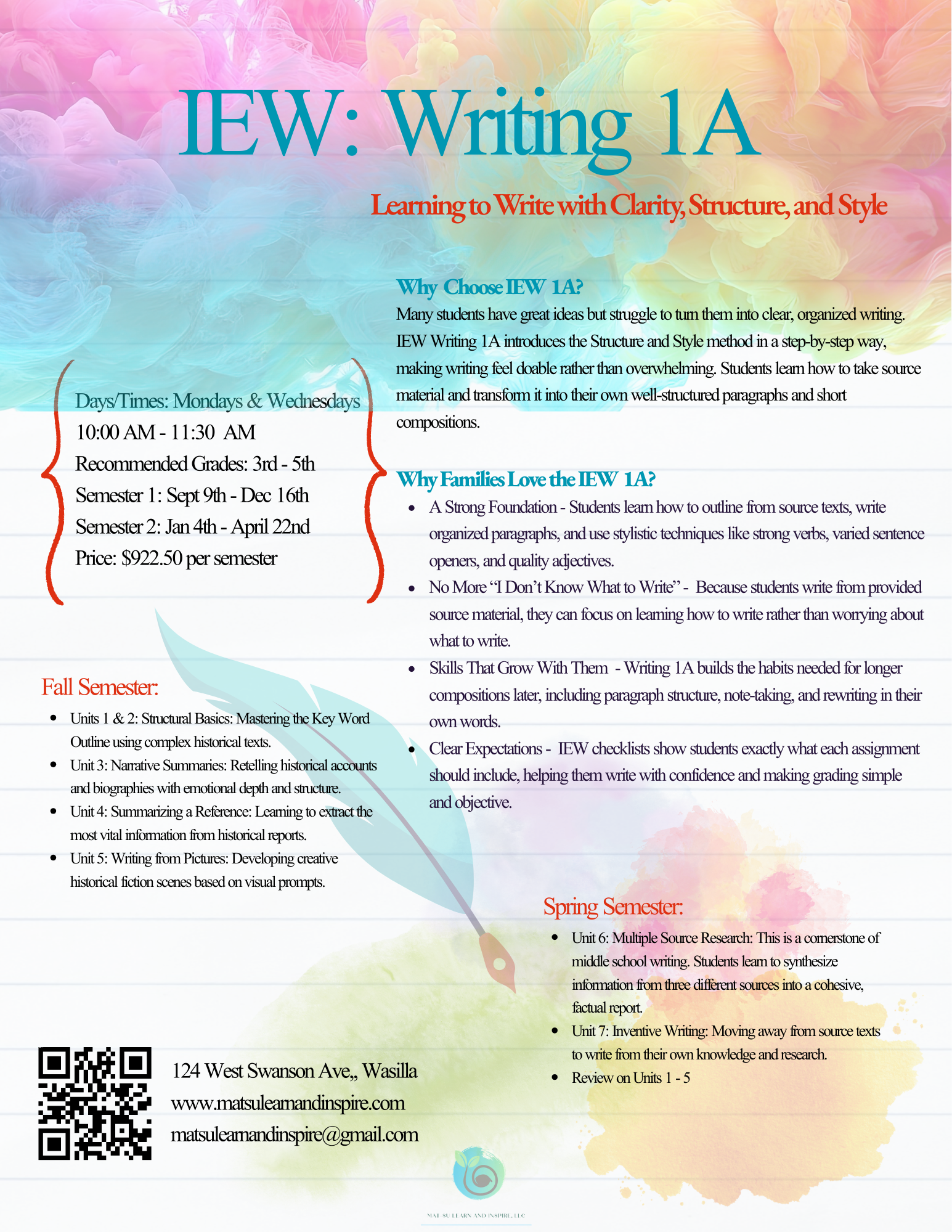
Writing 1A: Structure and Style - 3rd - 5th Grade - Fall Semester
Why Choose IEW 1A?
Many students have great ideas but struggle to turn them into clear, organized writing. IEW Writing 1A introduces the Structure and Style method in a step-by-step way, making writing feel doable rather than overwhelming. Students learn how to take source material and transform it into their own well-structured paragraphs and short compositions.
Why Families Love the IEW 1A?
A Strong Foundation - Students learn how to outline from source texts, write organized paragraphs, and use stylistic techniques like strong verbs, varied sentence openers, and quality adjectives.
No More “I Don’t Know What to Write” - Because students write from provided source material, they can focus on learning how to write rather than worrying about what to write.
Skills That Grow With Them - Writing 1A builds the habits needed for longer compositions later, including paragraph structure, note-taking, and rewriting in their own words.
Clear Expectations - IEW checklists show students exactly what each assignment should include, helping them write with confidence and making grading simple and objective.
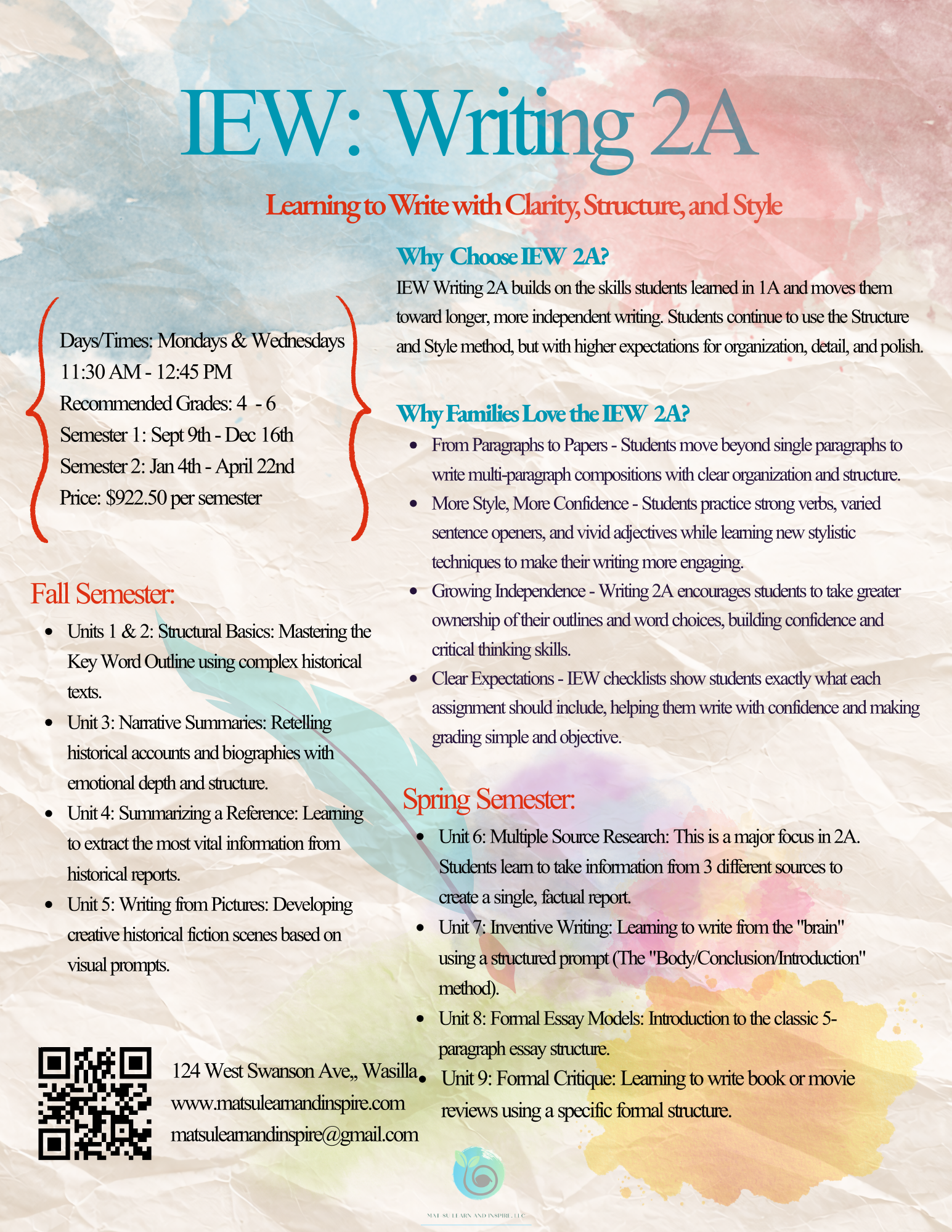
Writing Structure and Style Level 2A (4th-5th) Fall Semester
Why Choose IEW 2A?
IEW Writing 2A builds on the skills students learned in 1A and moves them toward longer, more independent writing. Students continue to use the Structure and Style method, but with higher expectations for organization, detail, and polish.
Why Families Love IEW 2A
From Paragraphs to Papers
Students move beyond single paragraphs to write multi-paragraph compositions with clear organization and structure.
More Style, More Confidence
Students practice strong verbs, varied sentence openers, and vivid adjectives while learning new stylistic techniques to make their writing more engaging.
Growing Independence
Writing 2A encourages students to take greater ownership of their outlines and word choices, building confidence and critical thinking skills.
Clear Expectations
IEW checklists show students exactly what each assignment should include, helping them write with confidence and making grading simple and objective.
IEW: Investigations in Writing 6th - 8th - Spring Semester
Why Choose IEW for Middle School?
Many students know what they want to say but don’t know how to get it onto the page. This Modern World History-based writing course uses the IEW Structure and Style method to help students organize their thoughts and turn writing into a predictable, manageable process.
Why Families Love the IEW Method:
A Proven Toolbox - Instead of vague instructions like “be more descriptive,” students learn specific tools such as strong verbs, varied sentence openers, and clear paragraph structure.
No More “What Do I Write?” - Using historical events as source material gives students something concrete to write about so they can focus on writing clearly and confidently.
College & Career Ready - Students build skills in structured paragraphs, 5-paragraph essays, and multi-source research, preparing them for high school and beyond.
The Power of the Checklist - IEW checklists clearly show students what a finished paper should include, taking the guesswork out of both writing and grading.
Writing 1A: Structure and Style - 3rd - 5th Grade Spring Semester
Why Choose IEW 1A?
Many students have great ideas but struggle to turn them into clear, organized writing. IEW Writing 1A introduces the Structure and Style method in a step-by-step way, making writing feel doable rather than overwhelming. Students learn how to take source material and transform it into their own well-structured paragraphs and short compositions.
Why Families Love the IEW 1A?
A Strong Foundation - Students learn how to outline from source texts, write organized paragraphs, and use stylistic techniques like strong verbs, varied sentence openers, and quality adjectives.
No More “I Don’t Know What to Write” - Because students write from provided source material, they can focus on learning how to write rather than worrying about what to write.
Skills That Grow With Them - Writing 1A builds the habits needed for longer compositions later, including paragraph structure, note-taking, and rewriting in their own words.
Clear Expectations - IEW checklists show students exactly what each assignment should include, helping them write with confidence and making grading simple and objective.
Wind and Waves: Spring Semester
This hands-on course is designed specifically for Kindergarten through 3rd graders, blending wonder-filled discovery with essential classroom skills. We use The Good and the Beautiful curriculum to investigate the powerful forces of weather and the mysteries of the deep blue sea.
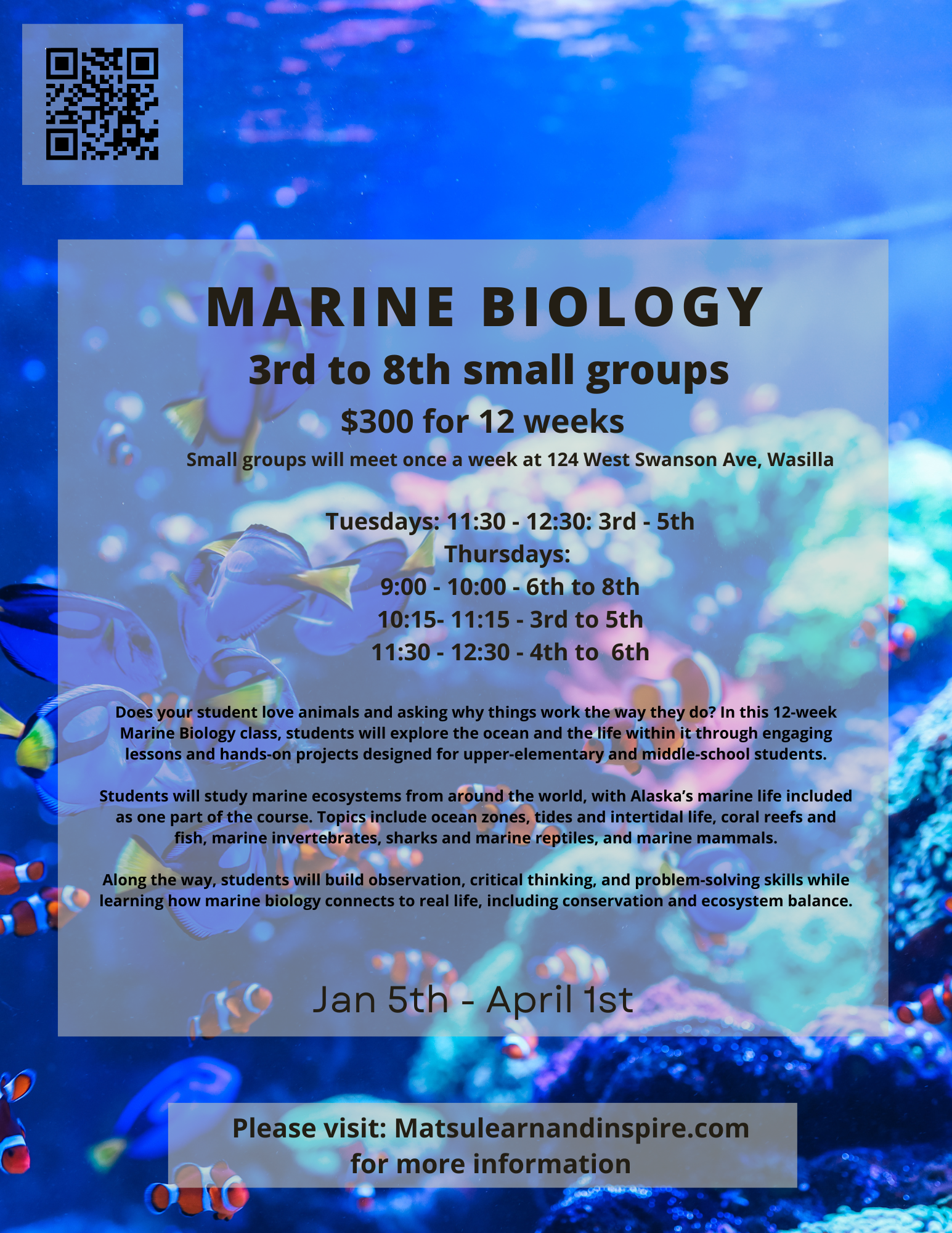
Marine Biology: 3rd - 8th Grade Science
Does your student love animals and asking why things work the way they do? In this 12-week Marine Biology class, students will explore the ocean and the life within it through engaging lessons and hands-on projects designed for upper-elementary and middle-school students.
Students will study marine ecosystems from around the world, with Alaska’s marine life included as one part of the course. Topics include ocean zones, tides and intertidal life, coral reefs and fish, marine invertebrates, sharks and marine reptiles, and marine mammals.
Along the way, students will build observation, critical thinking, and problem-solving skills while learning how marine biology connects to real life, including conservation and ecosystem balance.
Answers: Moses - Hosea
Students will explore the Bible from Moses through the prophet Hosea, discovering how God worked through His people and revealed His plan of redemption. Lessons include God’s deliverance of Israel from Egypt, the giving of the Law, life in the Promised Land, the time of the Judges, the rise and fall of Israel’s kings, and the messages of the prophets. Children will learn about obedience, trust, repentance, and God’s faithful love, while seeing how these stories fit together as one big story pointing to Jesus.
Writing Structure and Style Level 2A (4th-5th) Spring Semester
Why Choose IEW 2A?
IEW Writing 2A builds on the skills students learned in 1A and moves them toward longer, more independent writing. Students continue to use the Structure and Style method, but with higher expectations for organization, detail, and polish.
Why Families Love IEW 2A
From Paragraphs to Papers
Students move beyond single paragraphs to write multi-paragraph compositions with clear organization and structure.
More Style, More Confidence
Students practice strong verbs, varied sentence openers, and vivid adjectives while learning new stylistic techniques to make their writing more engaging.
Growing Independence
Writing 2A encourages students to take greater ownership of their outlines and word choices, building confidence and critical thinking skills.
Clear Expectations
IEW checklists show students exactly what each assignment should include, helping them write with confidence and making grading simple and objective.

Health and the Physical Body 3rd- 8th
In this exciting science unit, students will explore how the human body is designed and how its systems work together to keep us strong and healthy. We'll begin by learning how the body is formed and move into how we digest food, absorb nutrients, and stay energized through nutrition, vitamins, and hydration.
Students will study the Renal System, Circulatory System (heart and blood), and Respiratory System, seeing how these parts keep our bodies balanced and fueled. We'll also explore the Skeletal and Musculoskeletal Systems, understanding how bones and muscles support movement and strength.
Lessons on the Integumentary System (skin, hair, and nails) will show how our bodies protect us, while practical topics like Germs and Hygiene will teach students how to stay healthy.
We'll finish by exploring Genes and Unique Features, celebrating what makes each person special. Hands-on activities, videos, and journals keep learning fun and interactive